

Description
PrymaLab · Research Use Only
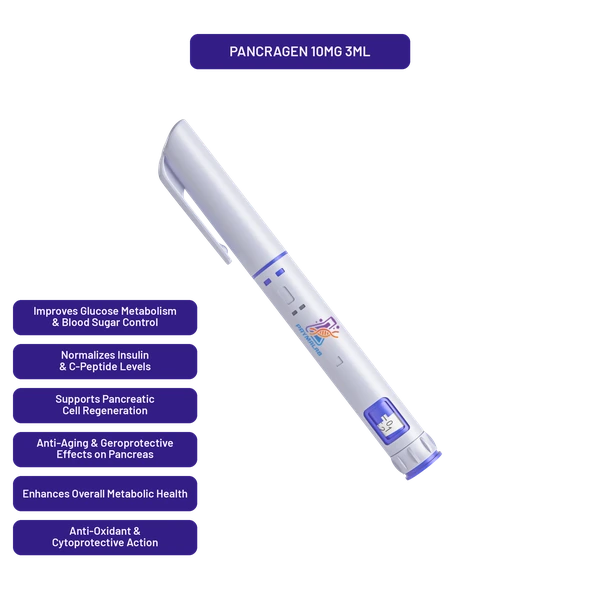
Preloaded Autoinjector | Pancragen | 3ml Pen | 20mg
Khavinson tetrapeptide in solution · 3ml at 20/3 mg/ml · No reconstitution step
The Pancragen pen is a preloaded 3ml research device holding the tetrapeptide Lys-Glu-Asp-Trp in solution at 20/3 mg/ml, giving 20mg in total. Its C-terminal tryptophan is the one residue in the molecule that oxidises readily, so light exposure and dissolved oxygen matter more here than for the other Khavinson bioregulators.
Specification Table
| Property | Value |
|---|---|
| Device format | Preloaded autoinjector pen, glass cartridge |
| Fill volume | 3 ml |
| Concentration | 20/3 mg/ml |
| Total compound in device | 20 mg |
| Molar concentration | (20/3) / 576.6 x 1000 mM. A 10 mg fill gives 5.78 mM |
| Compound | Pancragen, Lys-Glu-Asp-Trp tetrapeptide (KEDW) |
| CAS number | None assigned. PubChem CID 68451868 carries no CAS; vendor-quoted numbers are unverified |
| Molecular formula | C26H36N6O9 (free acid) or C26H37N7O8 (amide) |
| Molecular weight | 576.61 g/mol free acid; 575.62 g/mol amide |
| Amino acid sequence | Lys-Glu-Asp-Trp |
| Solution appearance | Not published on the product record. Confirm against certificate of analysis |
| Reconstitution required | None. Supplied as solution |
| Excipient system | Not published on the product record. Confirm against certificate of analysis |
| Solution pH | Not published on the product record |
| Storage | 2-8°C, protected from light, do not freeze |
| Light sensitivity | Material. Tryptophan absorbs at 280 nm and photo-oxidises |
| Solution stability | No published study of this tetrapeptide in solution exists |
| C-terminal form | Amide or free acid, 1 Da apart. Confirm against certificate of analysis |
| Acid-labile bond | Asp3-Trp4 |
| Salt form | Acetate per vendor documents; trifluoroacetate if not exchanged after chromatography. Unverified per lot |
| Purity | Per lot-specific certificate of analysis |
| Regulatory status | No approval by FDA, EMA, PMDA, TGA or Health Canada in any jurisdiction |
What Changes When Pancragen Ships in Solution?
Dissolving this tetrapeptide starts a clock on one residue: the C-terminal tryptophan, which is the only oxidation-prone group in a molecule that otherwise gives water very little to work on.
Read the sequence and what is absent matters as much as what is present. Lys-Glu-Asp-Trp contains no methionine, no cysteine, no asparagine, no glutamine and no histidine. That rules out thioether oxidation, disulfide scrambling and side-chain deamidation in a single stroke, and those three routes account for most of what goes wrong in aqueous peptide formulations. The N-terminal residue is lysine rather than glutamine or glutamate, so pyroglutamate formation has no starting point. Position two is glutamate rather than proline or glycine, so diketopiperazine cleavage, the classic failure mode of short peptides in water, is not the expected route here either.
What remains is tryptophan. Grosvenor, Morton and Dyer profiled residue-level photo-oxidative damage in synthetic peptides in 2010 and catalogued the product set: hydroxytryptophan at a mass shift of plus 16 daltons, N-formylkynurenine at plus 32, and kynurenine at roughly plus 4. Kynurenine-type products absorb in the near-visible, which is why oxidised tryptophan solutions turn yellow. A colourless solution that has gone straw-coloured has already told the researcher something, and it is the only degradation route in this molecule that announces itself without instrumentation.
The second route is quieter. Aspartate at position three sits immediately before the tryptophan, and Asp-X amide bonds are the most acid-labile in peptide chemistry. Manning and colleagues set out the mechanism in their 2010 review: the aspartate side chain closes onto the backbone nitrogen to form a succinimide, which reopens to give either normal aspartate or the isomeric isoAsp. With tryptophan following rather than glycine or serine the rate is moderate rather than fast, but it is real at low pH, and isomerisation changes nothing about the mass. A pen solution can accumulate isoAsp-Pancragen indefinitely and every mass spectrum will look correct.
Then there is the question of which molecule is in the cartridge at all. Khavinson and colleagues wrote Lys-Glu-Asp-Trp-NH2 in 2007 and again in the 2020 Molecules paper, and the inventors’ own US patent 7,491,703, priority date 10 December 2003, claims the C-terminal amide at 575.62. Most vendor certificates describe the free acid at 576.61. The two differ by 1 dalton and by rather more than that in behaviour: the calculated isoelectric point is about 4.0 for the acid, with three carboxylates against two amines, and about 6.6 for the amide, with two against two. At a formulation pH somewhere between 5 and 7 that is the difference between a distinctly anionic peptide and a near-neutral one, which in turn governs adsorption to glass and how the unpublished excipient system interacts with it.
No approved product of this compound exists anywhere, so there is no regulatory formulation decision to reason from. The Khavinson group made fresh intramuscular saline solutions for its animal work. Nobody has published what happens to this peptide left in a buffered cartridge for a year.
What Is Known About Pancragen Solution Stability?
Nothing has been measured. A September 2026 search of PubMed, Crossref and PubChem returned no forced-degradation study, no shelf-life data and no formulation work on KEDW in either its amide or free-acid form.
Everything written above about pancragen solution stability is therefore inference from residue chemistry rather than observation of this product. That inference is sound as far as it goes, because tryptophan oxidation and aspartate isomerisation are among the best-characterised reactions in peptide science, but inference and a stability-indicating assay are different objects. A real study would need to separate four things: tryptophan oxidation products by reversed-phase chromatography with diode-array detection, isoAsp by a method that resolves isomers rather than masses, hydrolysis of the C-terminal amide to the acid, and any loss of total peptide to the container wall.
Absence of published data is not a stability claim in either direction. It means the researcher buying a solution of this compound is accepting an unmeasured variable, and that the interval between fill date and use is worth recording alongside every result.
What Does the Pancragen Pen Deliver Per Increment?
The device holds 20 mg in 3 ml, so the concentration is 20/3 mg/ml and each 0.01 ml graduation carries 20/300 mg. Every quantity below follows from those two figures.
Molar concentration is (20/3) divided by 576.6 and multiplied by 1000 to give millimolar, or divided by 575.6 if the certificate of analysis names the amide. Worked through at a 10 mg fill: 3.33 mg/ml, 5.78 mM as the acid and 5.79 mM as the amide, 33.3 micrograms per 0.01 ml click and 333 micrograms per 0.1 ml.
Set that against the published quantities. Goncharova and colleagues gave old rhesus monkeys 50 micrograms per animal per day intramuscularly for 10 days, roughly 5 to 10 micrograms per kilogram. The inventors’ patent describes microgram quantities, which is two orders of magnitude below what a milligram-scale cartridge resolves: 10 micrograms out of a 10 mg pen is 0.003 ml, well under the smallest graduation. Matching literature quantities from this device means diluting out of it, not clicking down to them, and the arithmetic is worth doing on the peptide dilution calculator before the first draw rather than after.
Pancragen Pen vs Vial: Which Format Fits the Work?
A pen wins where repeated equivalent draws from one lot matter more than reaching low concentrations, and a vial wins where the material should stay dry until the day it is used. That is the whole of the pancragen pen vs vial question for this compound.
The case for the device is the elimination of reconstitution variance: diluent measurement error, incomplete dissolution, shear and adsorptive loss during transfer, none of which leave a trace in the notebook. A preloaded cartridge replaces all four with one concentration fixed at manufacture.
The case against is specific to the tryptophan. A lyophilized Pancragen vial keeps the peptide dry, dark and largely unreactive until the moment it meets water, and the oxidation clock starts on that day. A pen starts it at the fill line. For a compound whose principal solution-state risk is photo-oxidation of a single residue, that difference is not cosmetic. The general trade-off is set out in the comparison of pen and vial formats, and the rest of the preloaded autoinjector range shares the same device.
Pancragen Pen Storage and What It Protects Against
Store at 2-8°C, in the dark, without freezing. Each of those three instructions maps onto a named reaction in this molecule rather than onto generic caution.
Refrigeration slows the aspartate chemistry, temperature-driven like every succinimide reaction. Darkness addresses the tryptophan directly: the residue absorbs at 280 nm and photo-oxidises under near-ultraviolet light, so bench illumination between sessions is cumulative exposure rather than neutral time. Freezing concentrates solutes into the unfrozen fraction and shifts local pH, sometimes by more than a unit in phosphate systems, and a cartridge is not built to survive ice expansion. Pancragen pen storage in a domestic freezer compartment is the single most likely way to damage a device that would otherwise have been fine. The general storage and stability guidance covers the reasoning for the rest of the catalogue.
What the Product Record Does Not State
Six fields are missing, and the C-terminal form is the one that would change the most.
Total strength is not stated on the product record, which is why this page carries 20 rather than a figure. Excipient system: not published on the product record. Confirm against certificate of analysis. Solution pH: not published on the product record, and the aspartate route runs fastest at low pH while the tryptophan is largely pH-indifferent, so the number is worth having.
Beyond those, ask the supplier for three things a bioregulator certificate does not usually volunteer: whether the material is the amide or the free acid, which the mass spectrum resolves at 575.6 against 576.6; whether the counterion is acetate or residual trifluoroacetate from preparative chromatography; and the fill date, because for a solution product the fill date is the start of every stability question on this page.
Verifying a Pancragen Pen and Its Contents
This compound is one of the easier bioregulators to check, because tryptophan gives it a genuine ultraviolet chromophore that most short Khavinson peptides lack.
Absorbance at 280 nm is the first measurement. Tryptophan is the dominant absorber at that wavelength, so a diluted aliquot read against buffer gives a concentration estimate that is independent of whatever the label says. Run the full spectrum rather than the single point: growth of absorbance between 320 and 400 nm indicates kynurenine-type photoproducts, and that shoulder appears before the eye registers yellow.
Mass spectrometry answers the identity question and part of the degradation question at once. The parent ion distinguishes the amide from the acid by 1 dalton. Oxidation shows as plus 16 and plus 32 satellites. What mass spectrometry cannot see is the isoAsp isomer, which weighs exactly the same as the parent, so a chromatographic method that separates isomers is needed for that route.
Inspect each draw against a white card and record clarity, particulate and any tint. Let the device equilibrate to room temperature first, since cold solution is more viscous and viscosity changes delivered volume in a spring-driven mechanism.
What the Pancreagen Peptide Literature Reports
The published record on the pancreagen peptide consists of two small open-label human studies, work in old rhesus monkeys, streptozotocin-diabetic rats and pancreatic cell cultures, produced almost entirely by one St Petersburg group over roughly two decades.
Korkushko and colleagues reported in 2011 on 33 elderly patients with type 2 diabetes and 30 healthy elderly comparators, describing lower fasting and post-load glucose and lower plasma insulin. The design was open and not placebo-controlled, the abstract does not give dose or route, and the study was not registered. The companion 2010 paper in Problems of Endocrine Pathology comes from the same group. The inventors’ patent describes a further 36 diabetic patients, 20 treated against 16 controls, with reductions in insulin requirement, and patent data are not peer-reviewed data.
The animal record is more informative. Goncharova and colleagues reported in 2014 and again in 2015 on aged female rhesus monkeys given 50 micrograms per animal per day intramuscularly for 10 days, with improved glucose disappearance and normalised insulin and C-peptide responses that persisted partly for three weeks. Khavinson and colleagues in 2007 reported lower glucose after oral administration in streptozotocin-diabetic Wistar rats and normalised mesenteric capillary endothelial adhesion after the intramuscular route. The patent adds alloxan-diabetic rats with a 38 percent glucose reduction and lethality falling from 70 percent to 36 percent.
The mechanistic account is the group’s own. Their 2021 Molecules review reports that KEDW binds the DNA tetranucleotide motif ACCT and raises expression of nine pancreatic transcription-factor genes including PDX1, NGN3, PAX6, FOXA2 and PAX4 in cell culture. No laboratory outside that group and its collaborators has reproduced it. What is missing is more telling than what is present: no pharmacokinetic measurement of this tetrapeptide exists in any species, no dose-finding study, no blinded trial, no toxicology in English, and no work at all on the subcutaneous route this device implies. Broader context for the family sits in the research overview of peptide bioregulators.
Safety and Regulatory Position
No regulator has approved this compound in any form. Searches of FDA, EMA, PMDA, TGA and Health Canada registers found no marketing authorisation, and in Russia the Khavinson companies sell it as a dietary-supplement capsule rather than a registered injectable, a status this page records as unverified.
It does not appear on FDA’s 503B bulk-substance list as updated 21 March 2025, and it was not among the seven peptides FDA’s Pharmacy Compounding Advisory Committee reviewed on 23 and 24 July 2026 under Federal Register document 2026-07361, a list that covered BPC-157, KPV, TB-500, MOTS-c, emideltide, Semax and Epitalon. With no USP monograph, no place on the 503A bulks list and no status as a component of an approved drug, it is ineligible for compounding in the United States. No individual WADA entry exists for it, and section S0 is where non-approved substances sit.
No adverse findings appear in the abstracts of the studies above. That reflects the absence of systematic safety monitoring rather than demonstrated tolerability, and no toxicology package for this tetrapeptide has been published in English. Laboratory research is the only supply channel here, and the device is not offered for administration to any human or animal.
What Does the Pancragen Peptide Literature Actually Say?
This is the one Khavinson sequence with a mechanistic story specific enough to check. Reports on the Pancragen peptide describe increased expression of four pancreatic regulators in cultured cells: PDX1, PAX6, FOXA2 and PTF1A. Those four are the genuine master regulators of pancreatic cell differentiation. PDX1 specifies the pancreatic field in the early embryo and later maintains the beta cell. PTF1A drives the acinar lineage. PAX6 is required for alpha cells and contributes to beta cells. FOXA2 sits upstream of PDX1 and opens the chromatin it works in.
The experiments are cell-culture work on dispersed pancreatic tissue from young and old animals, with expression read by immunocytochemistry and PCR. The reported pattern is that expression falls with donor age and that adding the tetrapeptide raises it back toward the young-animal level, with PTF1A following the same direction. That is a coherent result and it is worth taking seriously as an observation.
What it is not is a demonstration of pancreatic function. Expression of a regulator in dispersed cells is several steps removed from insulin production, and no published study has followed the sequence through to hormone output, let alone to blood sugar in a living animal. Apoptosis endpoints appear in the same series, usually as caspase-3 activity, alongside cathepsin B and TNF-α as markers of stress and inflammation, and IGF-I as a growth signal. All are markers. None is an outcome.
Where Does the Metabolic Vocabulary Around This Compound Come From?
From the organ, not from the data. Because the pancreas makes insulin and glucagon, anything assigned to the pancreas attracts the whole diabetes vocabulary, and this synthetic tetrapeptide has collected it. Insulin resistance, chronic hyperglycemia, fasting glucose levels, glucose metabolism, glucose utilization and metabolic syndrome all appear in descriptions of this compound. None of them has been measured in any published study of KEDW.
That gap deserves to be stated in the sharpest terms available, because the reader most likely to find this page is looking for metabolic health information. Diabetes is a diagnosed condition with approved treatments, monitoring protocols and clinical guidelines, and no tetrapeptide bioregulator is among them. Nothing here has a documented effect on glucose. Endothelial function, which appears in secondary write-ups as a downstream benefit, has likewise never been an endpoint in work on this molecule.
Pancreatitis is worth separating out for the opposite reason. It is a serious condition, it is in the safety vocabulary of several approved metabolic medicines, and it has no established relationship with this peptide in either direction. No safety study of KEDW has been performed, so the compound has neither been shown to cause pancreatitis nor been shown not to. Silence is what the record contains.
What Should the Product Record and the Certificate State?
The C-terminal tryptophan governs everything about this material’s handling, and the certificate should reflect it. Ask for purity by HPLC at both 214 and 280 nm, since tryptophan gives this compound a real chromophore, and ask for an accurate mass, because the oxidation products sit sixteen and thirty-two daltons above the parent and are visible if the method is looking for them. Water content and counter-ion percentage complete a usable document.
A vial of this material ships as a lyophilized powder and is reconstituted with bacteriostatic water at the bench, so it can be kept dry, cold and dark until it is wanted. This pen ships as solution, which means the tryptophan has been sitting in water with dissolved oxygen since the fill date, and the fill date is not published on the product record. That single number matters more here than on almost any other device in the range.
No regulator has approved KEDW anywhere and no clinical trial of it has been registered. It is supplied for laboratory research only, and peptide therapy marketing that presents it as a metabolic intervention is describing a hope rather than a finding.
Published Literature
Each entry below was checked against the publisher record or a primary index before listing. None concerns this delivery format, on which nothing has been published.
- Khavinson VKh, Gavrisheva NA, Malinin VV, et al. Effect of pancragen on blood glucose level, capillary permeability and adhesion in rats with experimental diabetes mellitus. Bull Exp Biol Med. 2007;144(4):559-562. DOI: 10.1007/s10517-007-0377-3
- Korkushko OV, Khavinson VKh, Shatilo VB, et al. Prospects of using pancragen for correction of metabolic disorders in elderly people. Bull Exp Biol Med. 2011;151(4):454-456. DOI: 10.1007/s10517-011-1354-4
- Khavinson VKh, Durnova AO, Polyakova VO, et al. Effects of pancragen on the differentiation of pancreatic cells during their ageing. Bull Exp Biol Med. 2013;154(4):501-504. DOI: 10.1007/s10517-013-1987-6
- Goncharova ND, Ivanova LG, Oganian TE, et al. Impact of tetrapeptide pancragen on endocrine function of the pancreas in old monkeys. Adv Gerontol. 2014;27(4):662-667. PMID: 25946840
- Khavinson VKh. Peptides, genome, aging. Adv Gerontol. 2014;4(4):337-345. DOI: 10.1134/S2079057014040134
- Khavinson VK, Popovich IG, Linkova NS, et al. Peptide regulation of gene expression: a systematic review. Molecules. 2021;26(22):7053. DOI: 10.3390/molecules26227053
- Manning MC, Chou DK, Murphy BM, et al. Stability of protein pharmaceuticals: an update. Pharm Res. 2010;27(4):544-575. DOI: 10.1007/s11095-009-0045-6
- Grosvenor AJ, Morton JD, Dyer JM. Profiling of residue-level photo-oxidative damage in peptides. Amino Acids. 2010;39(1):285-296. DOI: 10.1007/s00726-009-0440-7
Frequently Asked Questions
What is the Pancragen pen?
A preloaded 3ml research device holding the tetrapeptide Lys-Glu-Asp-Trp in solution at 20/3 mg/ml, giving 20mg in total, with no reconstitution step. It is supplied strictly for laboratory research. No regulator anywhere has approved this compound in any form.
Which residue determines how this tetrapeptide behaves in water?
Tryptophan at position four. It is the only oxidation-prone residue present, converting to hydroxytryptophan at plus 16 daltons, N-formylkynurenine at plus 32 and kynurenine at about plus 4. Kynurenine products absorb near the visible range, so oxidised solutions yellow before any instrument is involved.
Has Pancragen solution stability been measured?
No. A September 2026 search of PubMed, Crossref and PubChem found no forced-degradation, shelf-life or formulation study of this tetrapeptide in either the amide or free-acid form. Everything on this page about its behaviour in water is inference from residue chemistry rather than measurement of this product.
Is the material in the cartridge the amide or the free acid?
The product record does not say, and the difference is real. The inventors’ patent 7,491,703 claims Lys-Glu-Asp-Trp-NH2 at 575.62, while most vendor certificates describe the free acid at 576.61. The calculated isoelectric point differs by roughly 2.6 units between them. Confirm against certificate of analysis.
What does one 0.01 ml increment deliver?
20/300 mg, which at a 10 mg fill is 33.3 micrograms. A 0.1 ml movement gives 20/30 mg, or 333 micrograms at that fill. Molar concentration is (20/3) divided by 576.6 then multiplied by 1000, giving 5.78 mM for a 10 mg device.
Can the device reach the quantities used in the published studies?
Not by clicking down to them. The patent works in microgram quantities, and 10 micrograms out of a 10 mg device is 0.003 ml, below its smallest graduation. Literature-equivalent quantities have to be reached by diluting a drawn volume rather than by the device increment itself.
Pancragen pen vs vial: which suits repeated sampling?
The pen, where equivalent draws from one lot across weeks matter more than reaching low concentrations. Reconstitution introduces diluent measurement error, incomplete dissolution, shear and adsorptive loss, none of which leave a record. A vial wins where the peptide should stay dry until the day of use.
What does Pancragen pen storage require?
2-8°C, dark, and no freezing. Refrigeration slows the aspartate isomerisation, darkness addresses tryptophan photo-oxidation at 280 nm, and freezing concentrates solutes into the unfrozen fraction while shifting local pH. Cartridge glass is also not built to survive ice expansion.
Why is the aspartate at position three worth watching?
Because Asp-X is the most acid-labile amide bond in peptide chemistry, and the aspartate side chain can close onto the backbone to form a succinimide that reopens as isoAsp. With tryptophan following rather than glycine, the rate is moderate. The isomer has the same mass, so mass spectrometry cannot detect it.
Which degradation routes does this sequence rule out?
Three of the common ones. There is no methionine, so no thioether oxidation; no cysteine, so no disulfide scrambling; no asparagine or glutamine, so no side-chain deamidation. Lysine at the N-terminus removes the pyroglutamate route, and glutamate at position two makes diketopiperazine cleavage unlikely.
How can the contents be checked without a dry cake to inspect?
Through ultraviolet absorbance, which this compound supports better than most bioregulators. Tryptophan dominates at 280 nm, so a diluted aliquot gives a label-independent concentration estimate. Absorbance growth between 320 and 400 nm signals kynurenine photoproducts well before the eye registers any yellow tint.
Should delivered volume be verified gravimetrically?
Once per device is reasonable. Actuate onto a tared vessel, record delivered mass, convert using solution density, and repeat across several actuations to capture both accuracy and precision. Let the cartridge reach room temperature first, since cold solution is more viscous and viscosity shifts delivered volume in a spring mechanism.
Is the pancreagen peptide the same molecule as Pancragen?
Yes. Pancreagen is the product-list spelling and Pancragen the spelling used in the Khavinson literature and on this site; both name the same KEDW tetrapeptide. The pancreagen peptide has no CAS number in PubChem, where the amide sits as CID 68451868 with a single depositor synonym.
What human evidence exists for this compound?
Two small open-label studies and patent data. Korkushko and colleagues reported in 2011 on 33 elderly patients with type 2 diabetes and 30 healthy comparators, with no placebo control, no registration and no dose in the abstract. The patent adds 36 patients, 20 treated against 16 controls.
What is the largest non-rodent dataset?
Aged female rhesus monkeys. Goncharova and colleagues reported in 2014 and 2015 that 50 micrograms per animal per day intramuscularly for 10 days improved glucose disappearance and normalised insulin and C-peptide responses, with part of the effect persisting three weeks after the course ended.
Has any pharmacokinetic study been done?
None, in any species. No measurement of absorption, distribution, half-life or clearance for this tetrapeptide has been published, which means the interval between a draw and any measured effect cannot be reasoned about from data. Short peptides of this size are generally cleared within minutes, but that has not been shown here.
Is the gene-expression mechanism independently confirmed?
No. The claim that KEDW binds the DNA motif ACCT and raises expression of nine pancreatic transcription-factor genes comes from the St Petersburg group’s own in vitro and modelling work, summarised in their 2021 Molecules review. No laboratory outside that group and its collaborators has reproduced it.
What is the regulatory position in the United States?
Ineligible for compounding and unapproved. The compound has no USP monograph, no place on the 503A bulks list and no status as a component of an approved drug. It was absent from FDA’s 503B list of 21 March 2025 and from the July 2026 Pharmacy Compounding Advisory Committee agenda.
What do the PDX1, PAX6 and FOXA2 results show?
That in cultured pancreatic tissue from older animals, expression of those transcription factors falls with donor age and rises toward young-animal levels when the tetrapeptide is added, with PTF1A moving the same way. All four are genuine master regulators of pancreatic cell differentiation. The work is cell culture read by immunocytochemistry and PCR, from one research programme.
Does that translate into pancreatic function?
Not on the published record. Regulator expression in dispersed cells is several steps from insulin production, and no study has followed the chain through to hormone output or to blood sugar in a living animal. The apoptosis endpoints reported alongside, caspase-3 activity with cathepsin B, TNF-α and IGF-I, are markers rather than outcomes.
Does this peptide affect blood sugar or insulin resistance?
Nothing here affects blood sugar in any documented way. Insulin resistance, chronic hyperglycemia, fasting glucose levels, glucose metabolism, glucose utilization and metabolic syndrome all appear in descriptions of this compound and none has been measured in a published study of it. Diabetes has approved treatments and no tetrapeptide bioregulator is among them.
Is there any relationship with pancreatitis?
None established in either direction. No safety study of this peptide has been performed, so it has neither been shown to cause that condition nor been shown not to. Endothelial function and metabolic health, which appear in secondary write-ups as downstream benefits, have likewise never been endpoints in work on this molecule.
What should the certificate of analysis show for this compound?
Purity by HPLC at both 214 and 280 nm, since the C-terminal tryptophan gives a real chromophore, plus accurate mass, water content and counter-ion percentage. Oxidation products sit sixteen and thirty-two daltons above the parent. A vial ships as lyophilized powder and can be kept dry; this pen has had its tryptophan in oxygenated water since a fill date the product record does not state.
Compliance Statement
The Pancragen autoinjector is sold exclusively for laboratory research use. It is not a drug, food, or cosmetic product, and it is not a dietary product of any kind. It is not approved by the FDA or any comparable authority for human or veterinary use. This product is not intended to diagnose, treat, cure, or prevent any disease. It must not be given to humans or animals. Purchase is restricted to qualified researchers and institutions operating within applicable laws. All handling is the responsibility of the purchasing laboratory.










Reviews
There are no reviews yet.